Adv. Mater. - Dynamic Dipole-Flipping Interlayer: Switchable Molecular-Level Electric Field Enables Full-Cycle Stable Zinc Anodes
Zhuanyi Liu, Zijian Xu, Junhong Guo, Feili Lai, Suli Chen*, and Tianxi Liu*
Advanced Materials 2026, DOI: 10.1002/adma.74759
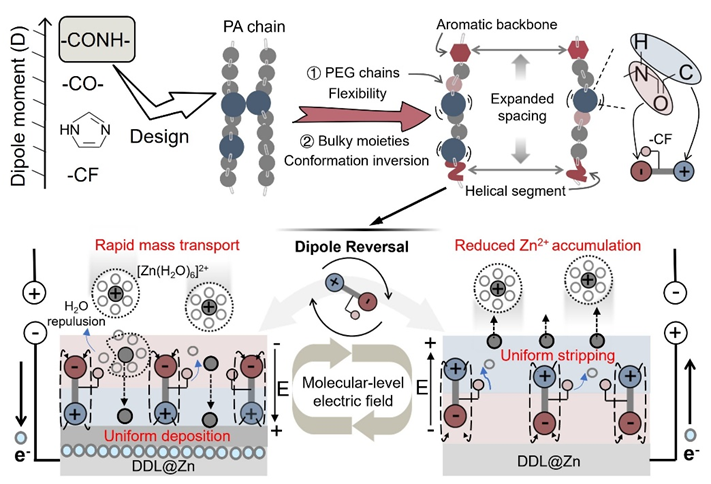
Nonuniform Zn2+ flux, which triggers dendritic growth and accompanying side reactions, severely bottlenecks the practical implementation of aqueous zinc-ion batteries. While the interfacial electric field governs Zn2+ flux uniformity, existing modulation strategies rely on static unidirectional fields remains intrinsically decoupled from the bidirectional, field-reversing dynamics of cyclic Zn deposition/stripping. Herein, we engineer a dynamic dipole-flipping interlayer (DDL) on Zn anode that generates a switchable molecular-level electric field to enable uniform Zn2+ flux regulation during cycling. Specifically, the DDL is constructed from a rationally designed polyamide derivative featuring inherently large amide dipole moments; increased free volume and chain flexibility disrupt dense chain packing and enable rapid, reversible dipole reorientation. During Zn deposition/stripping, the amide dipoles reorient dynamically to generate polarity-switchable interfacial molecular‑level electric fields, which direct homogeneous Zn2+ redistribution and suppress preferential nucleation. Beyond electric‑field regulation, fluorinated segments within the DDL impart interfacial hydrophobicity and further suppress side reactions. Consequently, the DDL-modified Zn anode cycles stably for over 3200 h at 0.5 mA cm−2, while the Zn||MnO2 full cell delivers 97.3% capacity retention after 1600 cycles at 1 A g−1. This work pioneers a versatile paradigm for interfacial electric field regulation by dipole dynamics toward high-performance aqueous metal-based batteries.
Link: https://doi.org/10.1002/adma.74759